
Blog Image

Acorn Health Blog

What we love is great health...

...and we like to write about how we can all achieve better health, naturally. Sometimes tips on how you can DIY to better health and sometimes on the therapies that can make a difference to you, your health and wellbeing.
Thank you for reading, We hope you enjoy :)

Plan the Imperfect wedding!

Therapies Posted on Thu, May 28, 2026 12:54PM

By Ranjana Mitra

As summer approaches, many couples are obsessing over the final details of their “perfect” wedding. Endless discussions about menus and table settings. Agonising over who makes the guest list, where to seat the awkward uncle, and how to include one child but no others. Vast amounts of time, emotional energy, and hard‑earned money are poured into getting everything just right. For some, even mealtimes lose their pleasure as the scales stubbornly refuse to cooperate.

But what is all this perfection actually for?

Will a flawless day and a beautiful wedding album rescue you when you stop speaking to each other for days after a serious disagreement? Will the memory of one glorious afternoon soothe you when a door is slammed and your partner storms out after a heated argument?

The raised voices, cold silences, and silent sulks will happen—not because love has faded, but because everyday life is messy and we are all imperfect. Love and good intentions alone do not smooth the bumps in a relationship. What matters is how you navigate the potholes without damaging the car beyond repair.

Instead of pouring all your resources into planning the perfect wedding, invest instead in the resilience of your partnership. Talk openly—and practice—how to manage differences without demanding your partner change who they are or abandon their values. Spend some of the money earmarked for the wedding on a pre wedding holiday somewhere that is on neither’s preferred list of destinations, but ticks some boxes for you both. See how you can learn to enjoy a compromise.

See whether you can compromise on the guest list or rethink the honeymoon destination if these become sticking points. Choose kindness. Invite your elderly aunt even if her social skills are lacking—quietly enjoying the celebration from the sidelines may be the highlight of her entire month.

If relatively minor issues feel non‑negotiable now, how will you handle the bigger challenges ahead—those that truly test your ability to listen, empathise, and find common ground? And what example will you set for your children as they learn how to navigate an imperfect world?

A fairytale wedding does not guarantee a fairytale life. But the ability to embrace—and even enjoy—an imperfect wedding may be one of the best indicators of a warm, happy, and beautifully imperfect relationship.

Dr Ranjana Mitra is a Relationship Counsellor specialising in Couples Therapy. She sees clients at Acorn Natural Health Centre in Heanor, Derbyshire.


Tourette Syndrome Awareness Month: Understanding Tics and Whole-Person Support

General Health & Wellbeing, Therapies Posted on Thu, May 28, 2026 11:50AM

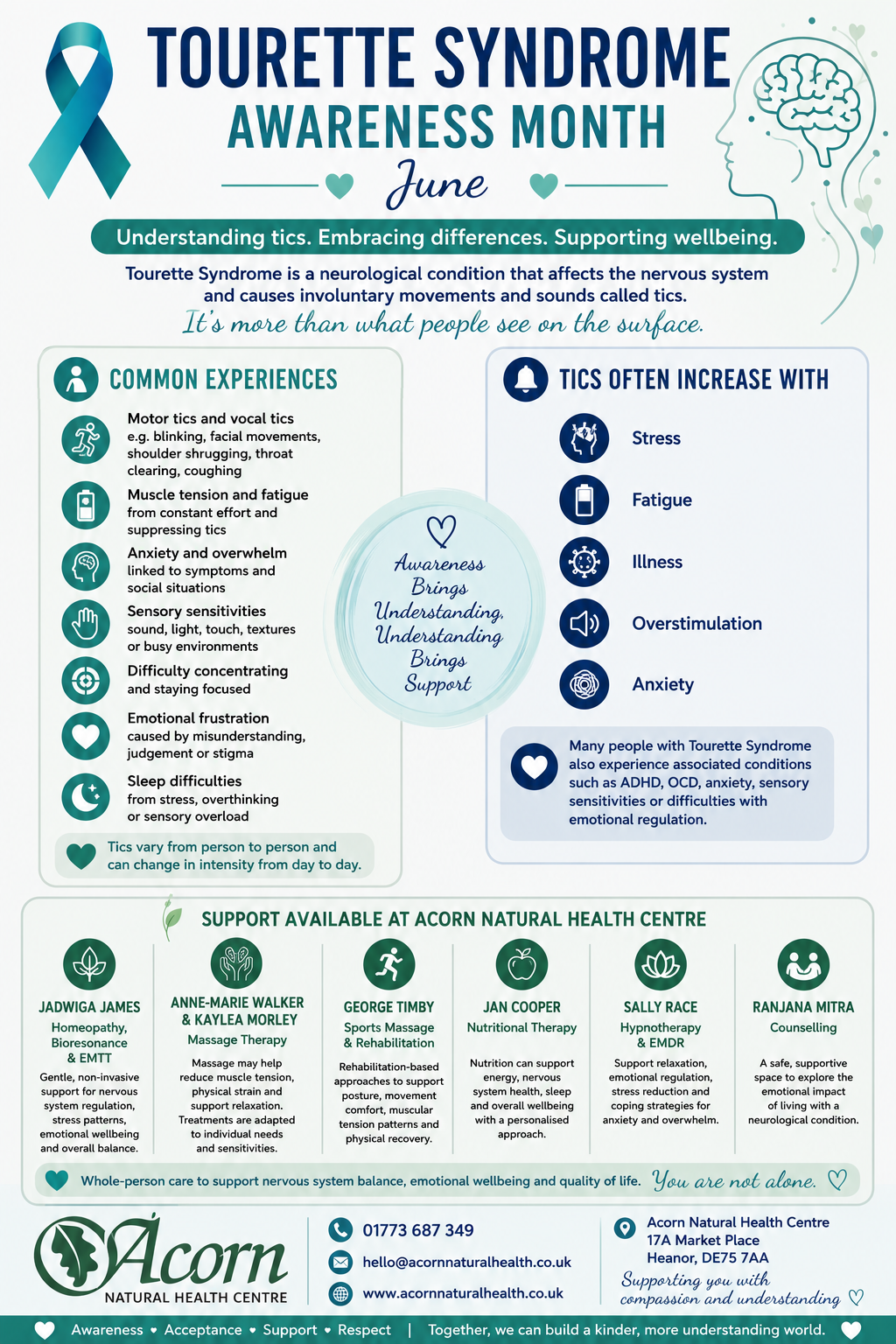
June is Tourette Syndrome Awareness Month, a time to raise understanding around a neurological condition that is often misunderstood or oversimplified.

Tourette Syndrome affects the nervous system and is characterised by tics, which are involuntary movements or sounds. These can vary from mild to more noticeable and often change over time in intensity and frequency.

Although many people associate Tourette Syndrome only with swearing or vocal outbursts, this is actually much less common than media portrayals suggest. For most people, Tourette Syndrome involves a combination of motor and vocal tics that can affect everyday life, confidence, concentration, and emotional wellbeing.

What is Tourette Syndrome?

Tourette Syndrome is a neurological condition that usually begins in childhood. Tics are not done deliberately and can become worse during periods of stress, fatigue, anxiety, illness, or overstimulation.

Common experiences can include:

Repeated blinking, facial movements, shoulder shrugging, or jerking movements

Vocal tics such as throat clearing, coughing, sniffing, or repeating sounds

A strong urge or sensation before a tic occurs

Difficulty suppressing tics for long periods

Fatigue from constant muscle tension or holding tics in

Anxiety, overwhelm, or emotional frustration linked to symptoms

Difficulties with focus, sensory processing, or sleep

Many people with Tourette Syndrome may also experience associated conditions such as ADHD, OCD, anxiety, sensory sensitivities, or difficulties with emotional regulation.

How Tourette Syndrome affects daily life

Tourette Syndrome can affect much more than visible tics alone. Many people describe the physical and emotional exhaustion that comes from trying to mask or suppress symptoms throughout the day.

School, work, social situations, and public spaces can sometimes feel stressful when there is fear of judgement or misunderstanding. Others may not realise the level of concentration and energy it takes to manage symptoms.

Tics often fluctuate. Some days may feel relatively calm, while other days symptoms can increase suddenly without a clear reason.

Stress and nervous system overload can also create a cycle where increased tension leads to more frequent or intense tics.

Why nervous system support matters

Tourette Syndrome involves the brain and nervous system, which means support often works best when it looks at the whole person rather than only the tic itself.

The aim is not to stop someone being themselves, but to support calmness, resilience, emotional wellbeing, and overall quality of life.

Support available for Tourette Syndrome

At Acorn Natural Health Centre, different approaches may help support nervous system regulation, emotional wellbeing, relaxation, and general balance. Each person’s experience is individual, so support is always tailored carefully.

Jadwiga James – Homeopathy, Bioresonance and EMTT

These approaches work with the body as a whole system and are often chosen by people looking for gentle, non-invasive support for nervous system regulation, stress patterns, emotional wellbeing, and long-term balance.

Anne Marie Walker & Kaylea Morley – Massage Therapy

Massage may help reduce muscular tension and physical strain that can build up from repeated movements and ongoing nervous system activation. Treatments are adapted to individual comfort levels and sensitivities.

George Timby – Sports Massage and Rehabilitation

Rehabilitation-based approaches may help support posture, muscular tension patterns, movement comfort, and physical recovery where repetitive movements have created strain or fatigue.

Jan Cooper – Nutritional Therapy

Nutrition can play a role in supporting energy, nervous system health, sleep, and overall wellbeing. A personalised approach may help identify dietary factors that influence stress, focus, or general balance.

Sally Race – Hypnotherapy and EMDR

Hypnotherapy and EMDR can help support relaxation, emotional regulation, stress reduction, and coping strategies for anxiety or overwhelm linked to symptoms and social pressures.

Ranjana Mitra – Counselling

Counselling provides a supportive space to explore the emotional impact of living with a neurological condition, including confidence, stress, frustration, social anxiety, and self-esteem.

Tourette Syndrome is a complex neurological condition that affects people in different ways. Greater awareness helps reduce stigma and encourages more understanding, patience, and support.

Many people with Tourette Syndrome live full, capable, creative lives. Feeling understood and supported can make a meaningful difference to confidence and wellbeing.

If you would like to learn more about Tourette Syndrome, visit Tourette’s Action, the UK charity supporting people living with tics and Tourette Syndrome.

Where we are

Acorn Natural Health Centre
17a Market Place, Heanor, DE75 7AA

Supporting clients across Heanor, Derbyshire, and surrounding areas.